
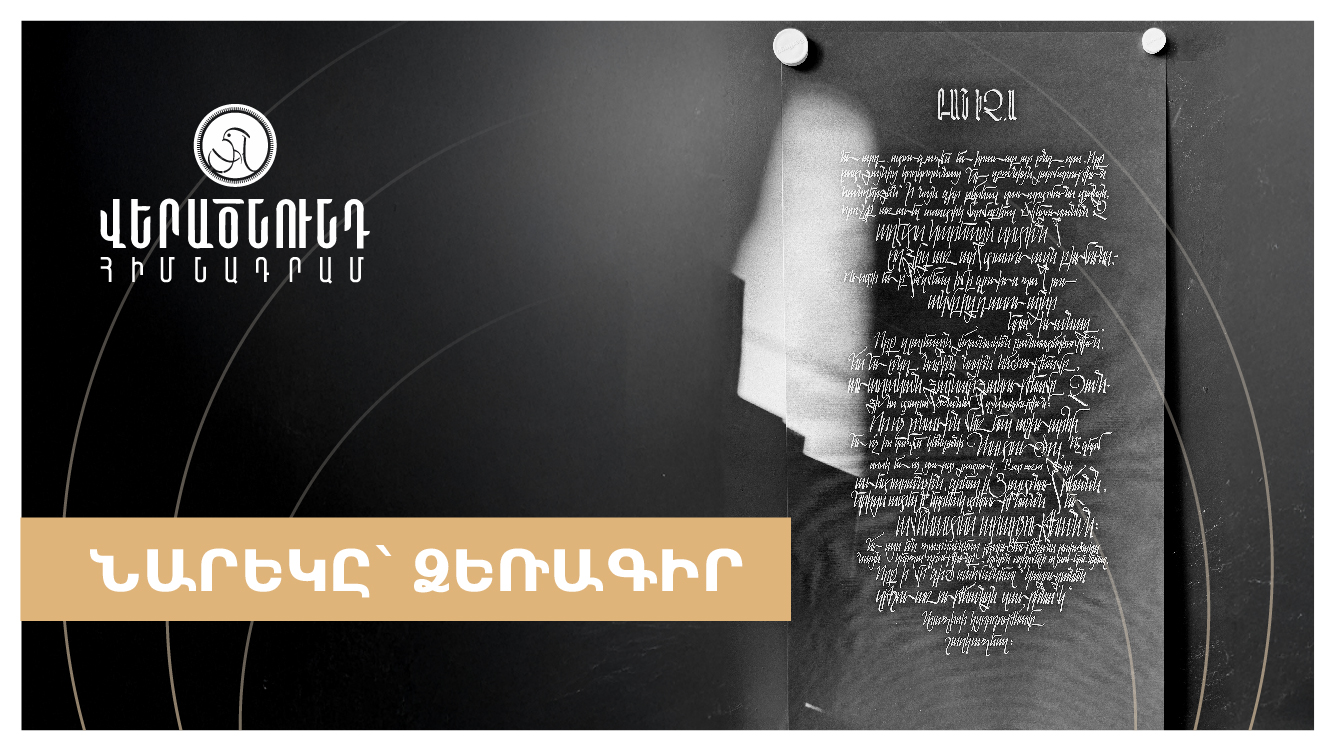
After centuries, the monumental work “Book of Lamentations” by Grigor Narekatsi is being rewritten by hand once again – this time in calligraphy. The manuscript is being created by calligrapher Ruben Malayan, at the initiative of Artur Janibekyan, founder of the Renaissance Foundation.
According to Ruben Malayan, the work itself is a journey – a path of which only part has been completed so far. “Book of Lamentations” consists of 95 chapters and more than 368,000 letters. For the manuscript, Italian black paper (140 grams, size 66×33) was selected. Writing on such paper is technically challenging: with every line, the paper must constantly be moved and repositioned. At the same time, this format allows the manuscript to be perceived as a unified whole.
“When was the last time the “Book of Lamentations” was handwritten? I don’t know. I think that after the invention of the printing press no one copied it by hand. I would not have started this work if it were not for Artur Janibekyan’s suggestion. The manuscript is extremely large, and the scale of the work is enormous. We decided that the handwritten version should be in Grabar. I constantly compare my writing with the original text in order to understand and fully perceive it myself. It is complex. In addition, the visual aspect adds another layer to my work, since it is done in calligraphy. My handwriting must be beautiful and aesthetic, built according to the rules of calligraphy, yet still legible.”
For a calligrapher, each page becomes a separate creation, a work of art. The manuscript will not be a traditionally bound book, as it may consist of around 1,000 pages.
“When I first started this ‘path,’ I had no idea where it would lead. I think Artur Janibekyan’s wish to rewrite Narek by hand is symbolic. This manuscript will certainly become a relic that can be exhibited in some of the most famous museums and exhibition halls in the world. I know how important all this is for Artur Janibekyan, because Narek is important to him. The period during which this manuscript is being created is also symbolic. We are living in very difficult times. Creating a handwritten Narek, returning to it again and again in a new way, may give us a certain inner balance.”
Malayan also notes that today reading handwritten texts has become difficult for many people. Therefore, the manuscript must be not only visually perfect and beautiful, but also clear and readable.
“I try to find the golden mean. For me readability is important, but calligraphy and visual aesthetics come first. Narek is a cosmic text, and our approach to it should also be ritualistic.”
While working on the manuscript, Malayan writes different pages in different calligraphic styles and scripts, choosing the form according to the meaning and visual rhythm of the text. He imagines all the pages placed side by side, forming a single artistic composition. Because the styles vary, the calligrapher also uses writing tools of different sizes and widths. In some sections the letters appear monolithic, while in others the text follows a more classical style.
Maintaining the rhythm of writing is also essential. Sometimes even a minor mistake forces the calligrapher to rewrite the entire page. Malayan believes that the manuscript may eventually be published as a printed edition as well, with the calligraphic manuscript on one page and the printed text on the other.